
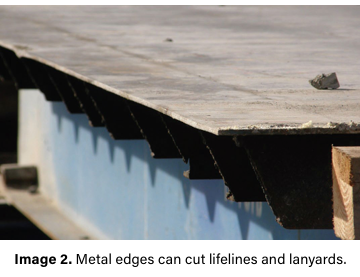
Lifelines, when properly anchored, can prevent a fall from occurring or stop a fallen worker from contacting a lower level. However, workers wearing a personal fall arrest system (PFAS) still can face a significant hazard if they fall and their lanyard is severed by an exposed edge.
Background
OSHA recently investigated a preventable incident where a worker using a PFAS was killed after the
lanyard was severed by an exposed edge during the fall. Evidence indicated the lifeline was damaged
during the fall, not before. In this case, the lanyard was not approved for working on or around sharp
edges. Lifeline manufacturers warn about the use of lifelines around edges that could damage the line
or prevent it from effectively arresting the fall. Some manufacturers have even developed Self-Retracting
Lanyards (SRL) designed for use around exposed edges (SRL-LE). Even when SRL-LE are used,
employers must still conduct a safety evaluation and identify where additional protection against sharp or
abrasive edges may be needed. Any open side or edge of a floor, roof, deck, platform, or formwork creates a condition in which a lifeline or lanyard could be severed if it contacts that edge during a fall.
Safe Work Practices for Employers to Follow:
PLAN ahead to get the job done safely:
Identify and document all potentially hazardous edges during the safety evaluation and walk-arounds at the jobsite. When possible, avoid working in areas where lifelines could contact potentially hazardous edges
should a fall occur. Identify possible solutions to prevent establishing anchors at feet level (see image 1)
Protect lifelines and lanyards against being severed or damaged by covering exposed edges in the fall zone (the area where a worker could fall) with protective material.
PROVIDE the right equipment:
Select and provide a lifeline or lanyard specifically designed to resist cuts and abrasions and follow the
manufacturer’s instructions for use. {Some manufacturers have lifelines and lanyards with the “LE” (leading edge) or similar designation which are designed specifically for bearing against an edge during an arrest.
Follow the manufacturer’s instructions for use.
TRAIN everyone to use the equipment safely:
Train workers on the hazard of exposed edges damaging or cutting lifelines and inform workers where
such edges are on the worksite. Follow the manufacturer’s instructions when anchoring SRL at feet level.
Train workers to anchor a self-retracting lifeline (SRL) vertically overhead, when possible, to prevent contact with an edge and minimize swing falls (i.e., the pendulum effect) that can damage and cut lifelines.
Ensure workers keep a safe distance from the overhead anchor point to minimize a swing fall. Spread out multiple lifelines, when possible, so employees can use the closest lifeline to minimize the swing radius and prevent contact with exposed edges.
Inspect Fall Protection Equipment Prior to Use, and Cover Exposed Edges Cover any exposed edge that a lifeline or lanyard could contact if a fall occurred, regardless of the edge’s composition. Ensure the protective material will not be moved by a lifeline or lanyard sliding across it. Limit fall distance or use another control method to avoid lanyard or lifeline contact with the edge, if covering is not feasible.
Employers are required to assess work hazards, including the risk of lifeline damage by following the
requirements in 29 CFR 1926.502(d)(11) and 29 CFR 1910.140(c)(20) – Lifelines shall be protected against
being cut or abraded (even those designated as SRL LE). Lanyards shall be inspected for serviceable
condition in accordance with 29 CFR 1926.502(d) (21) and 29 CFR 1910.140(c)(18) – Personal fall arrest
equipment must be inspected before use, and defective equipment shall be removed from service.
Employers must also ensure these requirements are being met:
29 CFR 1926 Subpart R, App G(d)(11), Lifelines shall be protected against being cut or abraded.
29 CFR 1926 Subpart R, App G(d)(21), Personal fall arrest systems shall be inspected prior to each use for
wear, damage and other deterioration, and defective components shall be removed from service.
Other Consensus Standards:
ANSI Z359.14 – 2021, Safety Requirements for
Self-Retracting Devices for Personal Fall A
